
How NLOS Uses Collective Intelligence, Technology Scale and Human Expertise to Build the Next Level Operating System for Recruiters and Recruiting Firms
Time for a Different Model
The SMB AI Trap begins with a structural disadvantage: an independent recruiting firm may have extraordinary expertise, but it rarely has enough scale to build its own AI infrastructure, influence major technology roadmaps or continuously integrate every new capability that emerges.
NLOS – the Next Level Operating System is designed around a different premise. The individual firm remains entrepreneurial and independent. But technologically, it no longer has to behave like an SMB.
NLOS is being built by recruiters and recruiting firm owners, for recruiters and recruiting firm owners. Its ambition is to become the intelligence and operating system for an entire recruiting business – bringing together the knowledge, processes, technology, AI, data, education, and collective experience required to operate, grow, and continuously improve a truly next-level recruiting firm.
The choice: a model where value moves upstream, or a network where intelligence and value compound back to participating firms.
The NLOS Ecosystem
Your ATS can remain the system of record where a firm’s proprietary data lives, while NLOS increasingly becomes the system of action and intelligence operating above it.
- NLOS-R | Recruiting – Search strategy, sourcing, candidate development, business development, process management, recruiting workflows, market intelligence, AI-enabled tools, and recruiter productivity.
- NLOS-O | Operations – Back-office processes, finance, reporting, contracts, compliance, onboarding, technology administration, workflow management, and operational and financial best practices.
- NLOS-M | Marketing Communications – Branding, content creation, social media, campaigns, client and candidate communications, presentations, websites, SEO, digital marketing best practices and more.
- NLOS-L | Learning & Development – Education, training, coaching, playbooks, proven best practices, skill development and personalized AI-supported learning for recruiters, leaders and owners.
NLOS will not be completed all at once. It will continue to evolve, with new components and capabilities added wherever they can deliver meaningful value to the network.
Your Data Stays Yours. The Intelligence Becomes Collective.
Each firm’s ATS data, candidate database, client relationships, contacts, search history, and proprietary intellectual property remain private and under the firm’s control.
What becomes collective is the intelligence that makes everyone better: proven workflows, AI prompts, best practices, market knowledge, business-development strategies, sourcing methodologies, interview frameworks, recruiting playbooks, process improvements, automation patterns, and successful strategies.
The objective is not to expose one firm’s proprietary information to another. The system learns from what works, not from who owns the data, and returns better workflows, recommendations and intelligence to the firms participating in the ecosystem.
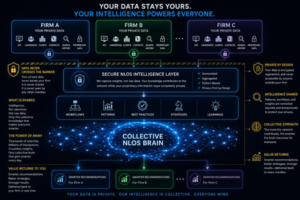
Your data stays yours. The intelligence becomes collective.
The Network Effect
Traditional software gives every customer essentially the same product. NLOS is designed to do the opposite: every new recruiting firm and recruiter that participates can make the platform more valuable for every existing member.
More firms participate. More real-world recruiting intelligence is captured. The system becomes smarter. Recruiters become more productive. Firms make more placements. More firms want access. The intelligence compounds.
Over time, the continually evolving recruiting brain can become more valuable than the software that delivers it. Software can be replicated. Another ATS can be built. Another CRM can be built. Another large language model can be connected to another API or MCP server. What is much harder to recreate is accumulated intelligence generated by thousands of recruiting interactions continuously refining a system purpose-built for recruiting.
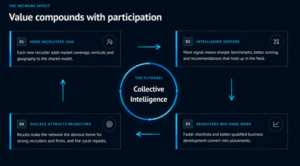
The network effect: value compounds with participation.
The Brain Cannot Be Copied
The software is the delivery mechanism. The deeper asset is the continually evolving recruiting brain behind it. Millions of recruiting interactions, workflows, patterns, best practices, and successful strategies can continuously refine a system purpose-built for recruiting.
Generic AI providers become smarter as customers use them, but the resulting platform intelligence ultimately belongs to the technology provider. NLOS is built around a different equation: members help build the network’s collective intelligence, with the knowledge staying inside the recruiting ecosystem.
No individual recruiting firm, regardless of size, could reasonably accumulate the breadth of interactions, workflows, and recruiting expertise that a large network can create together. Every recruiter, researcher, owner, trainer, and coach can contribute small improvements that collectively create something difficult for any one organization to replicate.
Collective Scale Changes the Technology Equation
There is another advantage to the collective model that may prove just as important as collective intelligence: influence.
A five-, ten-, or even fifty+-person recruiting firm can ask an ATS provider for deeper APIs, webhooks, MCP connectivity, expanded permissions, or custom integrations. But it remains one customer among hundreds or thousands. Its ability to influence the vendor’s development priorities is understandably limited.
NLOS changes that equation. Because the network represents a meaningful collective customer base, technology partners have an economic incentive to work with NLOS at a level that would be difficult for an individual SMB recruiting firm to achieve on its own.
Why API + MCP + Webhooks Matter
MCP alone can make an ATS dramatically more useful to AI. It gives an approved AI assistant a standardized way to understand the tools and data available inside the recruiting system and perform permitted actions.
But an AI connection alone is not the same as the infrastructure required to build an operating system. APIs provide reliable machine-to-machine access. Webhooks allow systems to react when important events occur. MCP gives AI agents a standardized interface to understand and operate the system. Large language models provide reasoning.
|
The API is the plumbing. MCP is the AI interface. The LLM provides the reasoning. NLOS is the intelligence and orchestration layer connecting them. |
Imagine a candidate moving to an interview stage in the ATS. A webhook can signal the event. The API can retrieve or update the necessary records. NLOS can evaluate whether compensation has been confirmed, whether interview preparation has occurred, what information is missing and what next-best action should occur. An AI agent can reason over the context, prepare the appropriate work, and involve the recruiter when human judgment, persuasion or relationship management is required.
The recruiter does not always have to ask the system what to do. The system can increasingly recognize what happened and help determine what should happen next. That is fundamentally different from simply putting an AI assistant on top of an ATS.
The Advantage SMBs Rarely Have: Influence Over the Roadmap
Through NLOS, thousands of recruiters and firms can approach the technology challenge as a collective. ATS partners do not have to justify development around the economics of a single 1-50+-person firm; they have the opportunity to help enable an ecosystem representing a significant collective customer base.
That leverage can help create access to deeper integrations, richer APIs, MCP capabilities, event-driven workflows and other infrastructure that an individual firm might struggle to secure, fund or maintain by itself.
The collective therefore creates two forms of leverage at the same time: collective intelligence and collective buying and influence power.
Aligned Technology Partners, Not a Closed Technology World
The answer to the SMB AI Trap is not to reject outside technology companies. Technology partners can provide enormous leverage. The critical issue is alignment.
Some of the recruiting sections of NLOS, NLOS-R, are built using hireEZ’s AI-native recruiting platform. We have also worked closely with PC Recruiter and Crelate on two-way integrations so firms can keep the ATS they already use. Others may follow in time. *NLOS and NLOS-R do not need an ATS connection for use, but a robust two-way connection provides a significant benefit
Steven Jiang, the founder of hireEZ, is a personal friend of our leadership team and has been invaluable in ensuring we have everything that hireEZ provides, along with everything else our dedicated in-house team can build, scale, and ensure adoption and value from the network. As Steven shared,
“Third-party search is fragmented by design, and the hard part is not the software; it is training and adoption. hireEZ already powers some of the largest search and staffing firms in the world. NLOS puts the same AI-native platform in the hands of independent firms, with one partner carrying the education and adoption at scale.”
The objective is not to use smaller firms as a proving ground on the way to a more economically attractive enterprise customer. The objective is to use the scale of the collective to help those firms become bigger, better and more valuable themselves.
Unlocking What’s to Come
Technology alone does not create transformation; successful adoption does. That is why NLOS is investing heavily in human enablement through a dedicated team of recruiting technology experts, forward deployment engineers, AI innovation leaders, and developers, all with years of recruiting and consulting expertise in our industry.
That team’s role is not simply to distribute software. It is to work directly with firms to implement NLOS, configure workflows, train recruiters and owners, optimize AI usage, increase adoption, improve productivity, and capture best practices.
Those real-world insights can feed back into product development. As recruiters discover better ways of working, those innovations can become part of the platform’s continuous evolution. Technology improves because the community improves.
Perhaps the greatest news for our industry and the most crucial point in this entire article is this:
As generic activity becomes increasingly automated, human judgment, relationships, persuasion, coaching, and trusted-advisor capability do not become less valuable. They become exponentially more valuable.
This may be the singularly best development our profession could ask for. AI will increasingly commoditize the routine, repetitive, and transactional parts of recruiting. But it cannot commoditize trust, wisdom, influence, empathy, or the ability to guide a client or candidate through a consequential decision. For great recruiters, AI is not the beginning of the end. It may be the beginning of their most valuable era yet.
“The more powerful the technology, the more valuable the human touch becomes.”
Institutional Knowledge Becomes an Asset
Experienced recruiters carry search strategies, client intelligence, candidate engagement techniques, market expertise, workflows, prompts, business-development methods, and competitive insights.
As work is increasingly captured inside an operating system, more of that knowledge can remain with the firm. Workflows remain. Playbooks remain. Optimizations remain. Institutional intelligence can keep creating value even as individuals move on.
The longer recruiters participate, the more intelligence they help create, the more value they receive, and the stronger the firm’s internal operating system can become. Shared success can therefore reinforce both productivity and retention.
Enterprise Technology at a Fraction of the Cost
Building a comparable recruiting-specific AI platform independently would require substantial engineering investment and ongoing operating expense. The underlying requirements include multi-agent orchestration, vector databases, workflow automation, search and enrichment pipelines, enterprise security, API and MCP/server integrations, analytics, custom recruiting intelligence layers, and much more.
Operating costs also scale with usage: AI token consumption, large language model usage, contact enrichment, API licensing, search infrastructure, cloud computing, monitoring, engineering, security, and continuous feature development.
The collective model spreads access to infrastructure and capabilities that would be prohibitively expensive for most independent firms to build and maintain alone.
NLOS is focused on reducing costs while improving platform capabilities and service levels. The return for NLOS is on the increased scale/revenue of every firm in the network. This ensures a continuously aligned interest focused on the same outcome. NLOS is also able to secure massive volumes of high-value data within the platform for the collective benefit of every firm in our network.
The Real AI Divide
AI will create extraordinary opportunities throughout recruiting industry. But the largest divide may not ultimately be between recruiters who use AI and recruiters who do not.
It may be between those who rent intelligence from companies whose economic interests can eventually diverge from theirs and those who participate in ecosystems where the technology becomes more valuable as the participants collectively become more successful.
Boutique recruiting firms possess something enormously valuable: decades of recruiting knowledge, specialization, relationships, judgment, and experience. Individually, few will ever have the scale or capital to build the AI infrastructure of the future. Collectively, they can create something no individual firm could build alone.
The NLOS Thesis
The future of recruiting will not be determined simply by which firms adopt AI fastest. It will be determined by who owns, controls and benefits from the intelligence that AI creates.
Keep each firm’s proprietary data private. Combine the intelligence that can make everyone better. Use technology partners where they create leverage. Surround the technology with recruiting expertise, valuable data, and human enablement. Create an economic model in which the success of the recruiting firm, not the increased value of the vendor, is the objective.
|
The next level isn’t simply having access to AI. It’s making sure the AI is being built for you – not merely built from you. |
That is the larger NLOS vision: an operating system designed around the needs of independent recruiting firms, connected to the systems they already use, powered by aligned technology partners and strengthened by the collective intelligence of the network.
ONE NETWORK. ONE OPERATING SYSTEM.
COLLECTIVE INTELLIGENCE. EXPONENTIAL PERFORMANCE.